Exposure data is a familiar problem among most asset allocators. The data exists, but rarely in a form that is consistent, timely, or easy to trust. It sits within portals and documents, it’s organized using varying formats, and turning it into something usable for investment teams can require significant manual effort by their colleagues in operations.
We discussed these challenges and how they can be addressed in our recent interactive webinar. Over the course of a live demo, audience polling, and plenty of Q&A, we looked at how teams manage exposure data today, the problems they encounter, and what changes when exposure data workflows are automated.
Recap: the core challenge
The discussion converged on a shared experience. Most alts investing firms can process exposure data, but it takes a lot of work before it’s ready to be used to assess investment strategies or guide decisions.
As a result, operations teams must spend time the preparing data, while investment teams have to wait for outputs that are unavoidably delayed and data points that can be difficult to verify.
Poll: what attendees told us
More than 60 investment and operations professionals participated in the webinar, with 43 responding to an instant poll about how they currently manage exposure data and their top challenges.
- 54 percent use a hybrid model (internal + outsourced data)
- 26 percent are fully outsourced
- 21 percent are fully manual
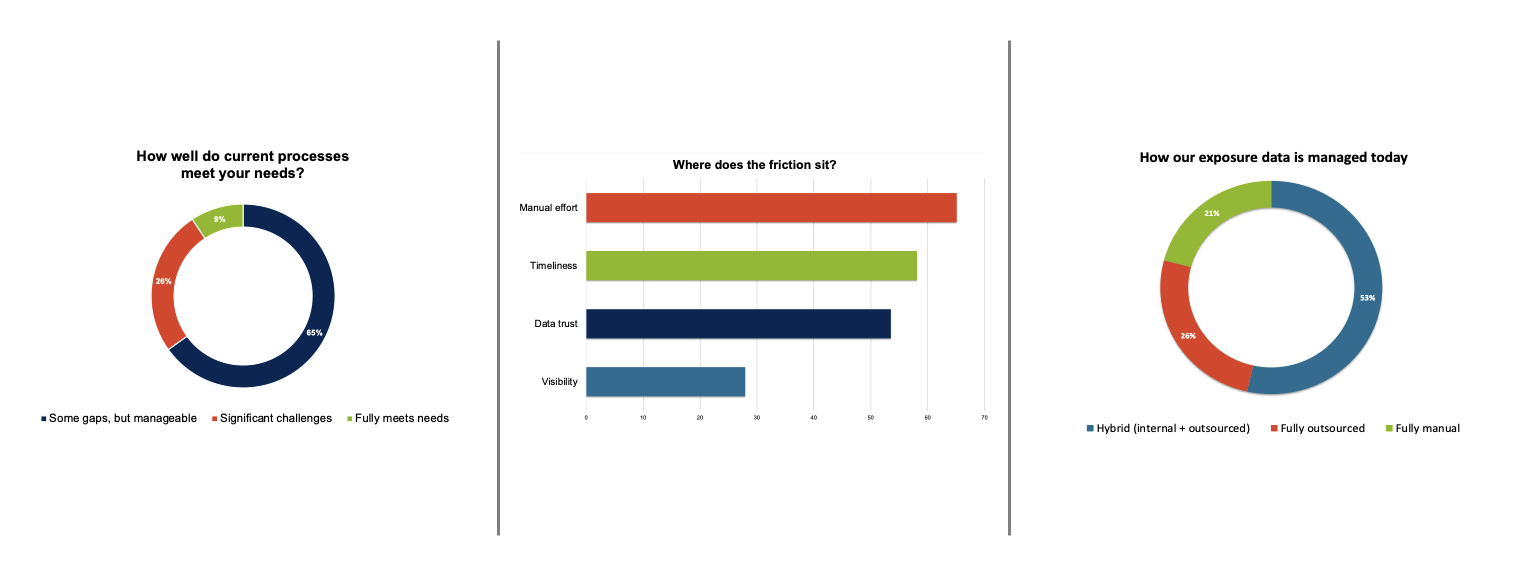
Just 9 percent said their process fully meets their needs. Two-thirds said there are gaps in their process, with around a quarter reporting significant challenges. The main areas of friction were manual effort (65 percent), timeliness (58 percent), and data trust (54 percent).
Taken together, the poll showed that while most teams have a process in place, they rely heavily on manual work and the output doesn’t fully meet requirements.
This isn’t due to a lack of effort or investment; all firms have an established process and most use conventional reporting from external providers either fully or in a hybrid model with their internal team. The issue that even with external reporting, manual work is needed to plug gaps – from capturing the data, labelling it to fit company taxonomies, reconciling inconsistencies, and validating outputs.
Goran Fattah, director of sales at Fundamatic, noted that the challenges are operational before they are analytical. The friction sits in the back office but shows up as usability and timeliness problems for investment teams. In practice, most firms are coping with compromises: the process works but requires ongoing effort and confidence in the output is not where it should be.
What we saw in the demo
Xavier Legros, founder and CEO of Fundamatic, delivered a demo of Atlas – the company’s solution to the exposure data problem. This focused on a highly automated process that reduces manual workloads and increases day accuracy as exposure reporting moves from documents into something usable.
Atlas begins with document capture. Manager reports (from portals, emails, or data rooms) are collected and organized as they arrive, removing the need for manual tracking. Holdings data is extracted directly from these documents, making underlying company-level data available almost as soon as new reports arrive.
The data is standardized so the same company appearing across multiple funds is recognized consistently, enabling a true look-through view. It is then enriched with context such as sector and geography.
A key element in solving one of the most persistent exposure data frustrations is the security master. Teams control how companies are classified, and those changes persist over time, removing repeated corrections. Finally, the data is made available within the Atlas interface and, for most users, through integrations with their downstream systems.
The overall shift is from a periodic, manual process to a continuous, automated process where exposure data is available within minutes of the underlying documents becoming available and with data accuracy (and therefore trust) becoming increasingly reliable over time.
What attendees wanted to know
The Q&A portion of the webinar was especially lively. Here are the attendees’ main questions and how they were answered by Xavier and Goran:
- How mature is Atlas?
Atlas is built on Fundamatic’s existing platform, which has been in use for several years and processes large volumes of real fund documents. Atlas extends that foundation specifically to exposure. - How do you handle managers that share data informally, not in structured documents?
Atlas is designed to work with unstructured inputs. As long as data is available in some form of written document, including emails or any format of attachment, it can be captured and standardized. - Is this limited to private equity, or does it work across other fund types?
Atlas works across asset classes, including hedge funds and other marketables, private credit, real estate, and other structures where holdings data is reported. - How much effort is required on the client side to get this working?
Atlas seamlessly fits into existing document automation workflows by connecting to current document sources rather than changing how teams operate. This keeps the implementation effort on the client side to a minimum and more concentrated on analysis of the output. - How quickly do teams start seeing usable exposure data?
Exposure data becomes available as documents are received and processed, removing delays associated with batch or quarterly cycles. - What changes day-to-day for operations teams?
Operations moves from building datasets manually to reviewing and governing them, shifting focus toward oversight rather than data preparation. - Can the data be pushed into a data warehouse?
Yes. Atlas supports structured outputs and integrations, allowing data to flow into our clients’ internal systems. - Can you support K-1 collection and reporting?
Yes, K-1 collection and reporting is supported within the broader Fundamatic platform, alongside other fund document workflows. - How are public securities handled, e.g. Bloomberg?
Atlas maintains a security master and enriches data using external sources where required, supporting both private and public holdings. - What happens when documents are missing or delayed?
The system tracks document flow and highlights gaps, allowing teams to assess completeness and reliability.
Closing point
Across the discussion, poll, and Q&A, the same conclusion came through: the central exposure data challenge is less about reporting and more about how the data moves from reports into a form that investment teams can use. Manual work that leads to delays and inaccuracies are the biggest impediments.
Atlas prepares exposure data using automation technology designed for the funds industry. It processes reports as soon as they come in, making the data accurate and available for investment teams within moments.
Next step
See how Atlas could be applied in your organization. Schedule a personalized demo with the Fundamatic team.
If you would like a more detailed look at Atlas and how it addresses the exposure data challenge, download our free eBook.
.png?width=200&height=50&name=BOOK%20A%20DEMO%20(2).png)